
Net and flat tax rates are used for a simplified settlement with the FTA, because for this purpose the input tax does not have to be determined.

Please enter a search term.
Error ~ No results could be loaded.
Use net rate or flat rate tax rates
Tutorial: Configure tax codes correctly for the different VAT settlement methods and work with net rate or flat rate tax codes.
Content
- Enter net rate tax / flat rate tax code
- Assign revenue account
- Create invoice document or book manually
- Evaluation by tax code
- Good to know
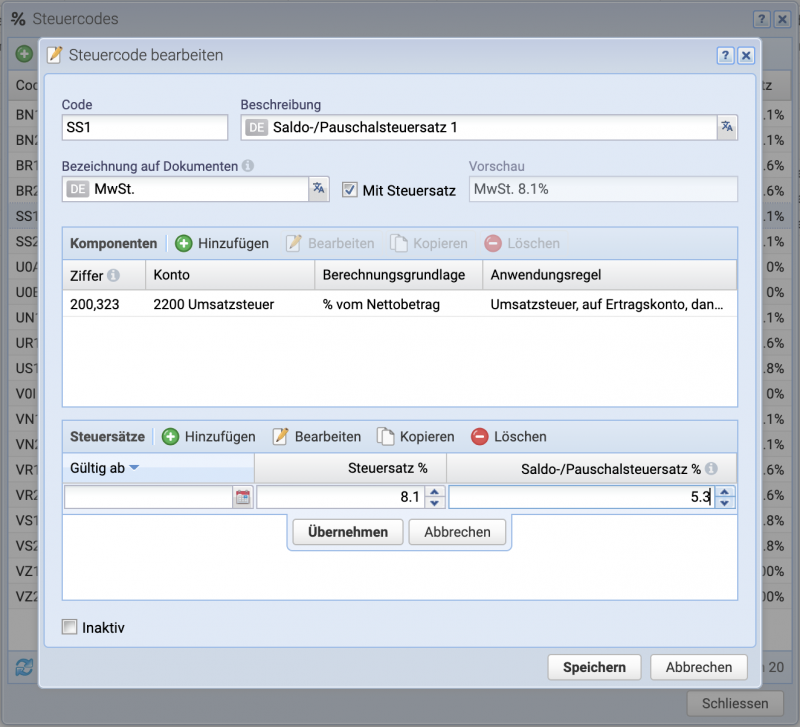
1. Create/ update tax code for net/ flat-rate tax
Via Settings Tax Codes, edit an existing tax code (e.g. SS1) or add a new tax code.
Fields Explained
- Code: Internal identifier for differentiation. Can be changed at any time.
- Description (multilingual ): Internal name of the tax code in the list. Do not enter the tax rate here. Can be changed at any time.
- Description on documents (multilingual ): Name displayed, e.g., on invoices
- With tax rate: For the label on documents (see preview next to it)
Components: Tax codes can contain one or more tax components. In the standard case, there is only one component. This is configured like this:
- Form number(s): for the VAT form
- Account: to which the tax is booked
- Calculation basis: For net/flat tax rate, it is always % of gross amount, regardless of what is set here.
- Application rule: whether the tax rate should be applied to the debit or credit side, etc.
Tax rates: The tax rate calculated via the tax code is entered here. There must always be exactly one tax rate without a validity date.
- Valid from: For changes to the tax rate, the validity date is entered here
- Tax rate: Percentage of the tax rate
- Balance/flat-rate tax rate: If applicable, enter the rate here
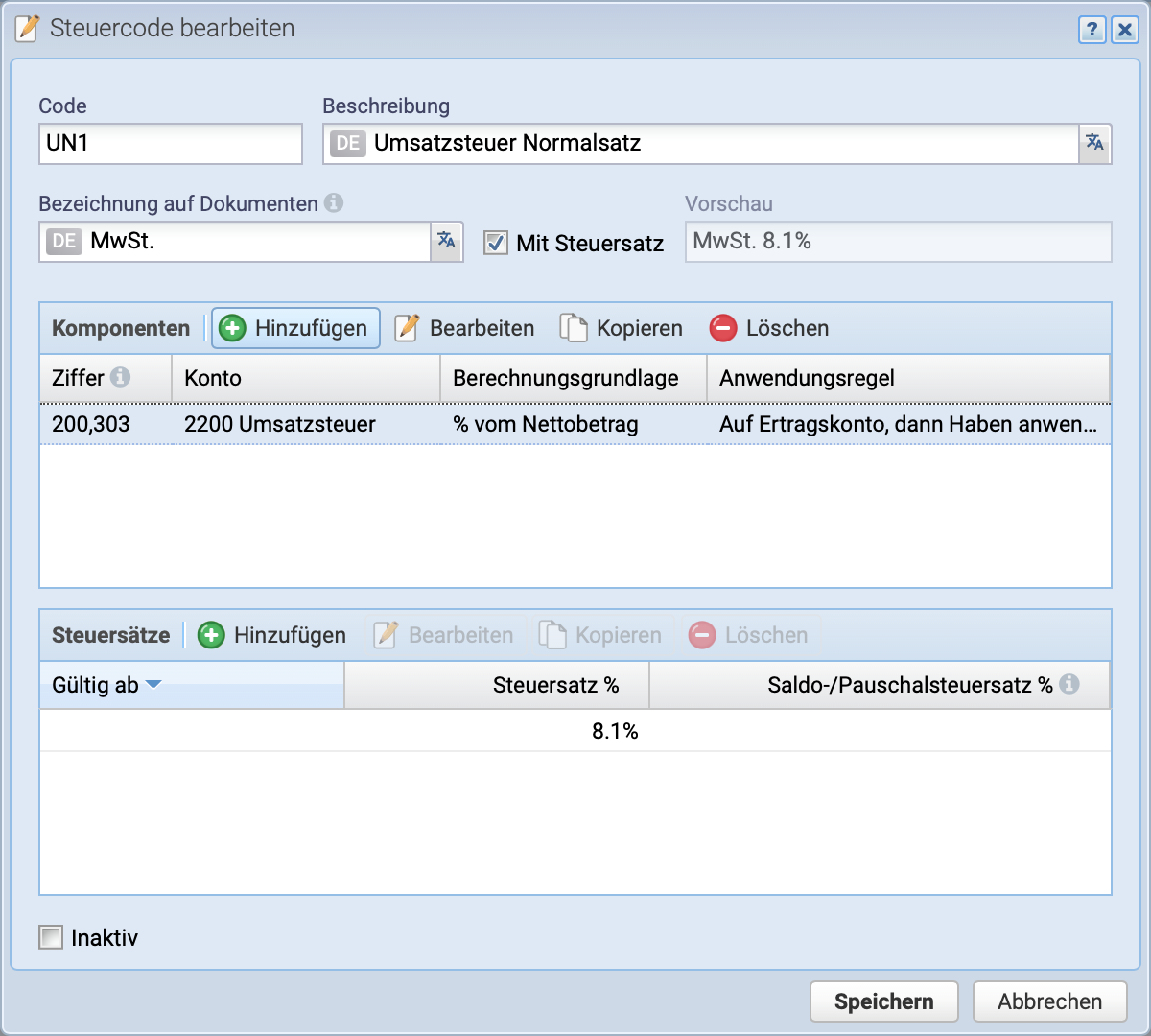
2. Assign revenue account
As with the regular tax codes, the net tax codes are also assigned to accounts. This is set in the Accounts module by double-clicking on the corresponding revenue account.
Once a tax code is assigned, it will be pre-filled in order documents for the income from items in the corresponding income accounts.
Only one rate can be assigned per account. Therefore, if services or items with different rates are sold, a revenue account must be created for each tax code.
3. Create invoice document or book manually
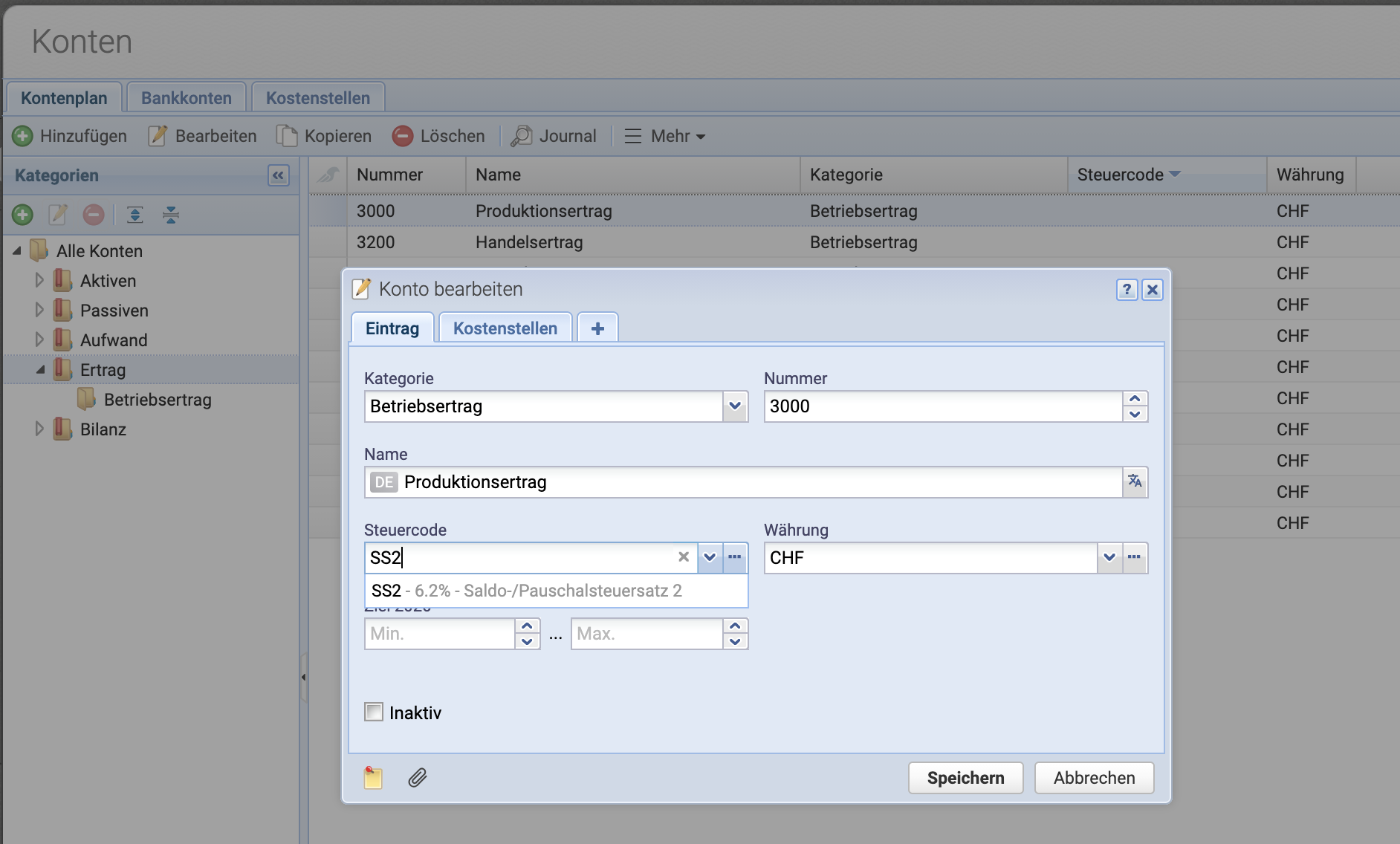
The tax rate stored for the flat-rate/net tax code is automatically applied to invoice documents. The document shows VAT at 8.1%, while CashCtrl simultaneously calculates in the background for payment to the tax authority using the reduced rate.
The same applies to manual book entries in the journal. For book entries with a balance/flat-rate tax, the stored rate is automatically applied in the dialog.
This is clearly shown in the screenshot: at the top, the VAT statement with a tax amount of 67.02; at the bottom, the invoice with a tax amount of 81.
4. Evaluation and payment of VAT
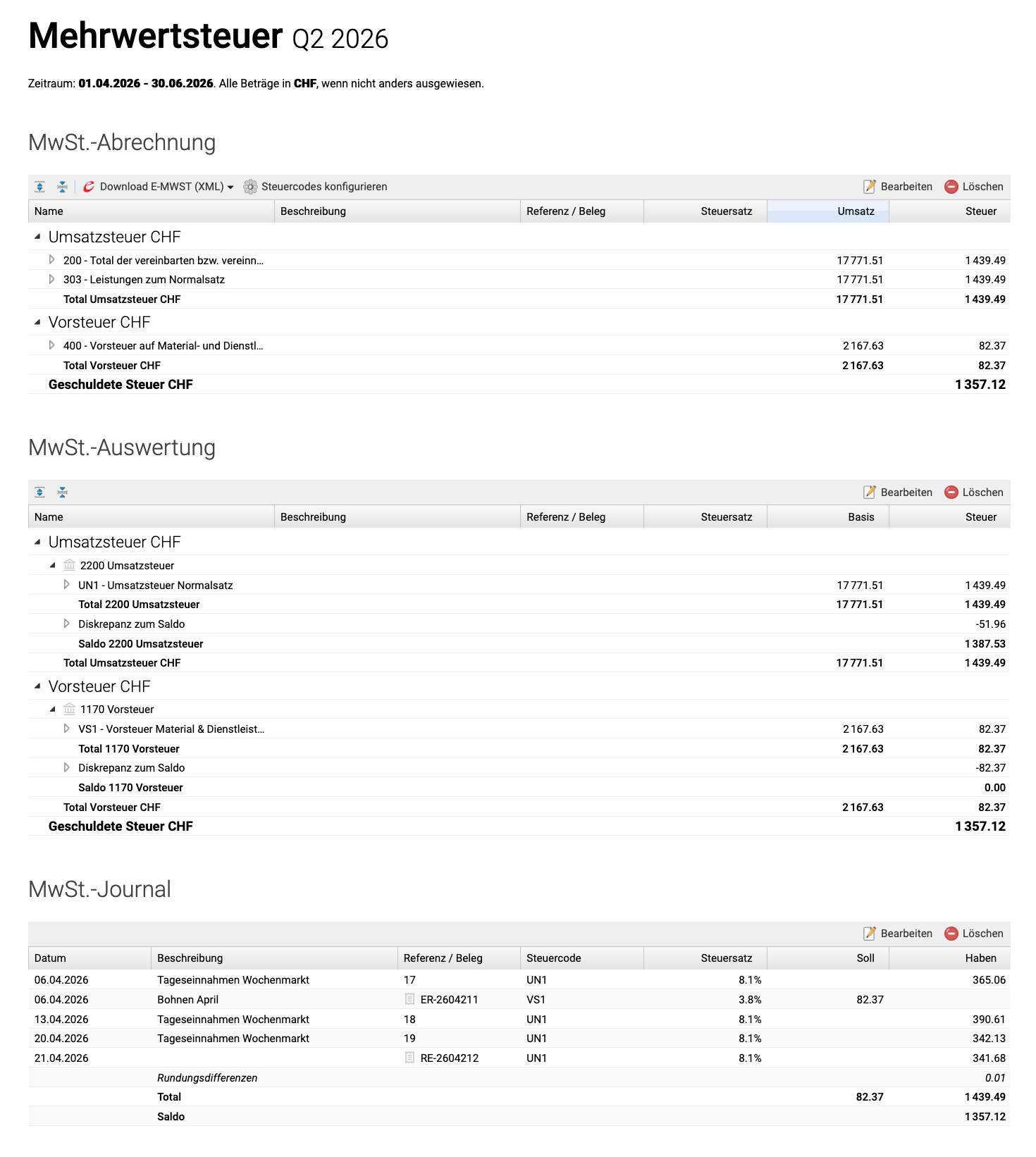
Open the VAT report collection via Reports. If not all reports are available yet (for organizations created before May 2026), create the reports via Add VAT.
VAT Settlement shows the tax owed, structured by form number.
VAT Evaluation displays any discrepancies between the account balances and the calculated tax.
VAT Journal lists all book entries booked with tax codes.
4. Evaluation and payment of VAT
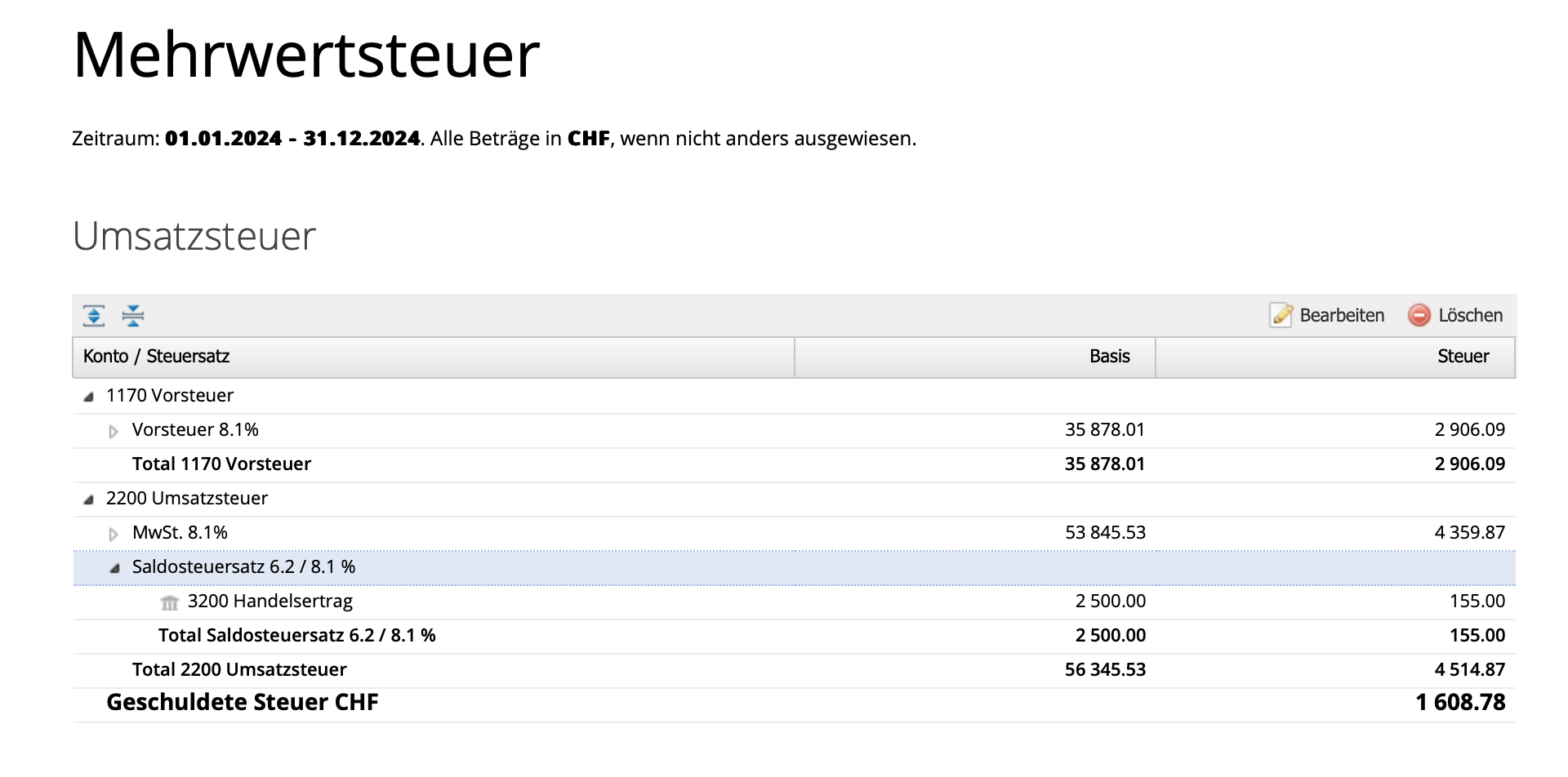
In the VAT report, the individual tax rates are broken down so that they can be transferred to the tax authority form.
The total due is then paid as a transfer to the tax authorities and booked against the account (default: 2200 VAT). This decreases the balance of the account.
Good to know
- The tax rates for net or flat-rate taxation are industry-specific and can be viewed on a list from the federal government. Whether net rate tax rates or flat rate tax rates can be applied must first be clarified. The following page of the Swiss Federal Tax Administration provides information on this: Federal Tax Administration FTA